
Shopping Cart
There are no more items in your cart
- News
- 0 likes
- 59 views
- 0 comments
In modern heavy industry and manufacturing facilities, rotating machinery constitutes the backbone of daily operations. From high-capacity industrial fans and slurry pumps to heavy gearboxes and high-speed electric motors, mechanical assemblies rely upon precision rolling element bearings to maintain alignment, carry complex radial and axial loads, and minimize mechanical friction. Despite advances in metallurgy and manufacturing precision, industrial plants consistently encounter unexpected downtime resulting from rotating equipment malfunction. Comprehensive failure evaluations confirm that unexpected machinery interruptions stem predominantly from identifiable, preventable operational deviations rather than theoretical material fatigue limits.
When industrial operators encounter bearing problems, treating the visible symptom without resolving the root cause inevitably leads to repetitive breakdowns, increased maintenance costs, and prolonged plant outages. Precision rolling interfaces operate within strict geometric, thermal, and chemical tolerances. When these parameters deviate, mechanical surfaces undergo progressive degradation, altering clearance and causing vibration. Addressing these challenges requires understanding physical damage mechanisms, executing accurate diagnostic techniques, and selecting precision-engineered components from trusted suppliers like Almabearings. This engineering guide examines the most common bearing problems, details their metallurgical and physical failure modes, and outlines actionable troubleshooting and corrective procedures.
Our Products: Angular Contact Ball Bearings
Lubrication-Related Bearing Problems
Lubrication failure remains the single largest operational contributor to premature bearing damage in industrial environments. A continuous elastohydrodynamic oil barrier prevents metallic asperities on rolling elements and raceways from coming into direct contact. When this lubricating separation deteriorates, high contact temperatures develop, initiating adhesive wear. Lubrication-related issues generally fall into three distinct operational categories: under-lubrication, over-lubrication, and incorrect lubricant selection.
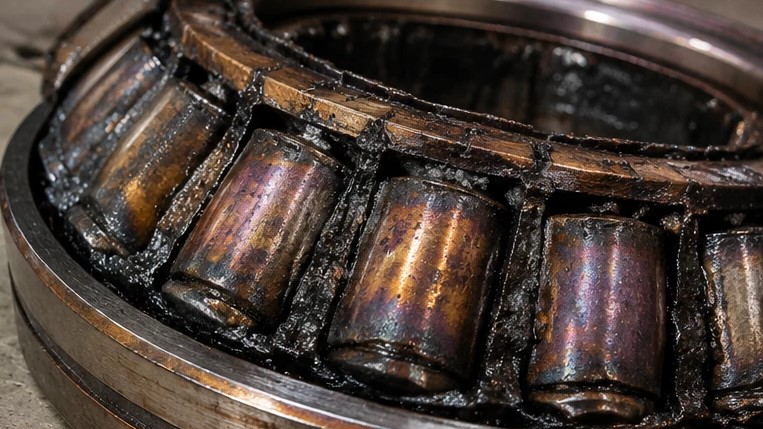
Under-lubrication occurs when lubricant replenishment intervals are inadequate, when delivery lines clog, or when excessive operating temperatures cause base oil evaporation. Without sufficient oil supply, rolling elements enter the boundary lubrication regime. Asperities shear against one another, generating localized micro-welds that tear free, creating a frosted, scuffed appearance across raceways. Over time, friction increases operational temperatures, causing the hardened bearing steel to lose its temper. This softens the metal and causes rapid dimensional collapse.
Conversely, over-lubrication is an equally detrimental condition that frequently goes unrecognized. When maintenance personnel inject excessive grease into a bearing cavity without allowing excess lubricant to vent, the rotating elements must push through viscous fluid resistance. This phenomenon, known as fluid churning, generates excessive internal shear friction. Internal temperatures spike rapidly, accelerating grease thickener separation, base oil oxidation, and thermal seal degradation. Furthermore, using a lubricant with incorrect base oil viscosity compromises asset life. If the viscosity is too low, the oil film cannot support the applied load. If the viscosity is too high, viscous drag increases energy consumption and running temperatures.
| Problem Category | Specific Failure Mechanism | Observable Symptoms | Corrective Engineering Action |
|---|---|---|---|
| Lubrication Failure | Starvation, grease churning, viscosity mismatch | Scuffing, discoloration, high temperature, grease degradation | Calculate grease replenishment intervals; apply ultrasound-guided greasing |
| Mechanical Misalignment | Angular/parallel offset, shaft deflection | Diagonal wear paths, edge loading, axial vibration spikes | Perform precision laser shaft alignment; inspect housing tolerances |
| Electrical Erosion | Parasitic shaft voltages, VFD circulating currents | Fluting patterns, micro-pitting, blackened grease | Install shaft grounding brushes; use ceramic hybrid insulated bearings |
| Static Vibration | External vibration during plant standstill | False brinelling, transverse wear marks at roller pitch | Isolate idle machinery; rotate standby shafts regularly; damp foundations |
Mechanical Misalignment and Improper Fits
Mechanical installation errors represent another frequent category of bearing failure. Precision bearings require exact alignment between the rotating shaft centerline and the stationary housing bore. When angular or parallel misalignment occurs due to bent shafts, uneven foundation bolting (soft foot), or inaccurate mounting, the rolling elements track unevenly across raceways.
Misalignment forces the rolling elements to squeeze through the load zone along a diagonal trajectory rather than a centered, symmetrical track. This uneven tracking subjects bearing rings to extreme edge loading, stressing internal retainers and doubling local contact stresses. The elevated stress concentration accelerates surface fatigue, leading to premature raceway micro-cracking and spalling. Furthermore, excessive cage pocket wear occurs as rolling elements attempt to skew against the guide flanges. Misalignment also exerts irregular forces on contact seals, creating gap openings that allow external particulates to enter while permitting lubricant leakage.
Improper dimensional fits on shafts or within housings create severe mechanical issues. When an inner ring is mounted to an oversized shaft seat with excessive interference, hoop stress expands the inner ring outward. This expansion eliminates designed internal radial clearance. As a result, when the bearing reaches normal thermal equilibrium, internal clearances become negative, leading to heavy preloading, excessive frictional heat, and rapid seizure. Conversely, loose shaft or housing fits allow the bearing rings to creep or spin relative to their mating surfaces. Relative rotational sliding causes fretting wear, galling, and metal transfer, damaging precision shafts and generating abrasive iron oxide particles.
More Bearings: Spherical Plain Bearings
Contamination and Moisture Ingress
Rolling element bearings operate on microscopic lubricant films that are sensitive to solid particulate and liquid intrusion. Even small quantities of abrasive mineral dust, metallic filings, or moisture entering the bearing cavity compromise operating conditions.
Solid particulate contamination introduces abrasive particles into the contact zone. Hard foreign particulates puncture the lubricant barrier and indent precision-ground raceways under operating pressure. Each indentation creates a micro-crater surrounded by a raised metallic rim. As rolling elements pass over these raised rims, localized contact stresses multiply, initiating micro-fatigue cracks that propagate into severe surface flaking. Fine airborne contaminants act as a grinding slurry, causing continuous abrasive wear that widens internal clearances, degrades running accuracy, and induces excessive mechanical play.
Moisture ingress introduces both mechanical and chemical degradation. Free water inside a bearing housing displaces the lubricant film, causing boundary contact and additive depletion. Under high contact pressures, water molecules dissociate, releasing atomic hydrogen that diffuses into the steel lattice. This hydrogen embrittlement weakens the crystal structure and promotes rapid subsurface fatigue. Additionally, when equipment is idle, standing moisture causes galvanic corrosion, forming etched pits across rolling surfaces that act as permanent stress risers.
Electrical Erosion (Current Fluting)
With the widespread implementation of variable frequency drives (VFDs) and pulse-width modulation inverters across modern electric motors, electrical erosion has emerged as a frequent cause of bearing damage. VFDs induce high-frequency common-mode voltages on the motor rotor shaft. When this accumulated electrical potential exceeds the dielectric breakdown threshold of the thin lubricant film, electrical discharge machining occurs across the rolling contact interface.
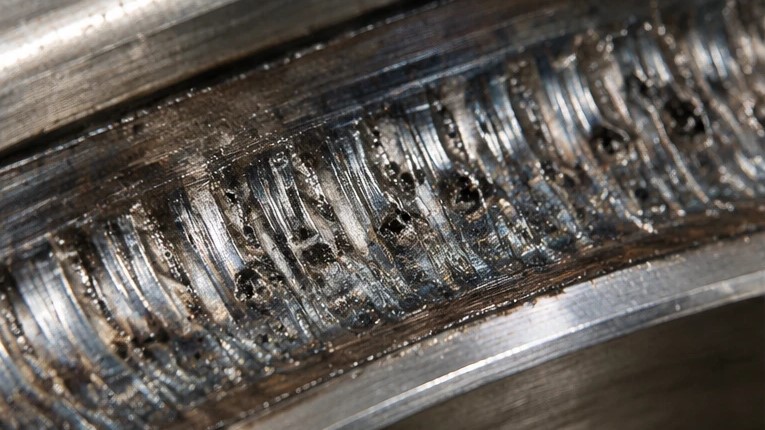
As the electric arc discharges through the bearing, localized flash temperatures melt microscopic areas of the steel raceway and rolling element. The rapid cooling that follows creates a hardened, brittle crater known as an electrical micro-pit. Over millions of discharge cycles, these micro-pits form a distinct, washboard-like pattern of transverse ridges along the raceways, a condition known as fluting. Fluting produces loud, high-pitched mechanical noise, severe high-frequency vibration, and rapid grease carbonization. The charred, degraded lubricant loses its ability to carry loads, leading to complete bearing seizure.
Static Vibration and True/False Brinelling
Mechanical brinelling describes permanent surface indentations caused by localized plastic deformation, divided into true brinelling and false brinelling based on root cause.
True brinelling occurs when a bearing experiences static shock loads or excessive impact forces beyond the yield strength of the steel. Common triggers include hammer blows during improper mounting, structural collisions, or heavy dropped loads. The resulting indentations mirror the precise spacing of the rolling elements and exhibit smooth, plastically deformed profiles without surface scuffing or material removal. Subsequent operation over these indentations causes immediate structural vibration and accelerates rolling contact fatigue.
False brinelling occurs when non-running machinery is subjected to external structural vibrations. In stationary standby pumps, spare motors stored near active equipment, or machinery transported without shaft locking mechanisms, rolling elements vibrate microscopically against raceways. Because the shaft is static, no hydrodynamic lubricant film forms to protect the interface. The vibrating elements push aside the stationary grease, initiating metal-to-metal contact that micro-welds and oxidizes surface asperities. This creates oxidized, reddish-brown depressions matching the roller spacing. When placed into service, these damaged contact zones generate elevated noise and rapid vibration wear.
Our Products: Ball Bearings
| Diagnostic Method | Primary Measurement Parameter | Targeted Bearing Problem | Early Detection Window |
|---|---|---|---|
| Vibration Analysis | Velocity (RMS), PeakVue, acceleration demodulation | Misalignment, unbalance, outer/inner ring spalling, cage failure | Weeks to months prior to functional failure |
| Acoustic Ultrasound | High-frequency decibel level (dBµV), signal audio | Lubricant starvation, over-lubrication, micro-frictional rubbing | Earliest detection phase; real-time greasing feedback |
| Thermography | Infrared temperature profiles, housing thermal delta | Severe starvation, grease churning, tight clearance, seizure | Immediate indicator of active thermal distress |
| Lubricant Analysis | Particle count (ISO 4406), Karl Fischer moisture, wear debris | Contamination, water ingress, additive depletion, steel shedding | Continuous monitoring of fluid health and wear rates |
Diagnostic Techniques for Early Problem Detection
Implementing an effective predictive maintenance program requires multi-technology condition monitoring to identify bearing problems before functional failure occurs.
Vibration analysis serves as an effective methodology for identifying mechanical rotating faults. By collecting spectral vibration data, predictive maintenance engineers analyze specific defect frequencies: Ball Pass Frequency Outer (BPFO), Ball Pass Frequency Inner (BPFI), Ball Spin Frequency (BSF), and Fundamental Train Frequency (FTF). Early subsurface fatigue manifests as low-energy impacts detectable through high-frequency demodulation techniques. As surface spalling progresses, discrete peaks appear at the component’s kinematic fault frequency, eventually developing sidebands that indicate modulating mechanical looseness and severe degradation.
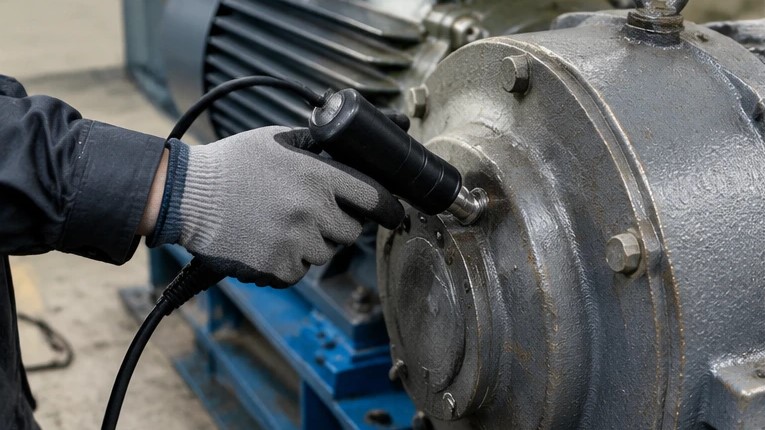
High-frequency structure-borne ultrasound provides an effective tool for assessing lubrication health. Ultrasound instruments capture the acoustic friction signals generated when rolling elements encounter poor lubrication conditions. By monitoring baseline decibel levels, technicians can detect lubrication starvation long before measurable temperature rises or vibration changes occur. Utilizing ultrasound during replenishment enables precision lubrication, preventing both starvation and over-lubrication.
Infrared thermography complements vibration and ultrasonic testing by mapping thermal gradients across bearing housings. A clear temperature increase between the bearing housing and surrounding framework indicates elevated internal friction, structural preloading, or grease churning. Routine oil sampling and wear debris analysis confirm internal wear mechanisms. Analytical ferrography distinguishes whether metallic wear debris originates from fatigue spalling, abrasive cutting, or corrosive etching, guiding targeted corrective actions. When structural upgrades are required, plant managers rely on Almabearings for precision-engineered components that resolve recurring operational problems.
Corrective Actions and Engineering Solutions
Addressing industrial bearing problems permanently requires systemic corrective interventions targeting the identified root causes.
Lubrication Strategy Optimization
Industrial operations must transition from arbitrary, time-based greasing schedules to condition-directed lubrication strategies. Calculating dynamic regreasing intervals based on operating speed, operating temperature, environmental contamination, and load ensures appropriate lubricant volumes. Utilizing ultrasonic listening devices during grease application allows technicians to monitor acoustic changes in real time, stopping grease injection when the decibel level stabilizes. For oil-lubricated sumps, installing desiccant breathers and constant-level oilers prevents moisture ingress while maintaining appropriate fluid volume.
Precision Installation and Alignment
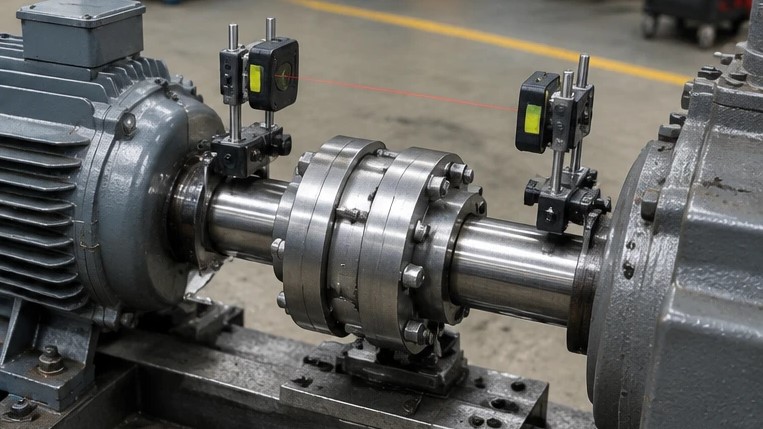
Eliminating mechanical stress requires standardized installation protocols. Hydraulic nuts, induction heaters with automatic demagnetization, and mechanical pullers should replace direct impact tools. Technicians must verify shaft and housing seat dimensions using precision micrometers, ensuring interference fits match manufacturer tolerances. Shaft systems must be aligned using multi-axis laser alignment tools, holding angular and parallel offsets within tight industrial tolerances (typically less than 0.05 mm for standard electric motor-pump couplings) to eliminate edge loading.
Advanced Sealing and Electrical Mitigation
For machinery operating in dirty or humid environments, conventional elastomeric lip seals should be replaced with non-contact labyrinth isolators or dual-face magnetic mechanical seals to prevent contaminant ingress without causing shaft wear. When addressing electrical erosion on VFD-driven electric motors, engineers should install circumferential shaft grounding rings to divert common-mode voltages safely to ground. In critical severe-duty applications, installing hybrid bearings featuring silicon nitride (ceramic) rolling elements or ceramic-coated steel rings provides electrical insulation, preventing current discharge and eliminating fluting damage.
Our Products: Roller Bearings
Conclusion: Achieving Long-Term Rotating Asset Reliability
Industrial bearing problems are not unavoidable operational occurrences; they are tangible indicators of mechanical, chemical, or operational abnormalities. Whether premature damage stems from lubrication starvation, shaft misalignment, abrasive contamination, or parasitic VFD electrical currents, each failure mode leaves clear diagnostic signatures on rolling elements and raceways. Moving from reactive component replacement to root cause analysis and condition monitoring enables facilities to optimize equipment reliability, protect capital investments, and prevent unscheduled plant shutdowns.
Modern reliability engineering requires a balanced approach combining accurate predictive maintenance diagnostics, rigorous installation procedures, and premium mechanical components. Implementing condition-based ultrasonic greasing, laser shaft alignment, and advanced labyrinth sealing ensures rotating assets achieve their full design life.
At Almabearings, we specialize in providing reliable industrial bearing solutions engineered to withstand demanding operational conditions. Our technical team works alongside plant engineers to analyze recurring failure modes, optimize internal clearance specifications, and supply high-performance bearings, including insulated hybrid units and spherical roller assemblies. Explore our precision product portfolio at Almabearings to resolve chronic bearing problems, extend maintenance intervals, and ensure dependable plant productivity.
Our Products: Deep Groove Ball Bearings
Frequently Asked Questions
1. What is the most common cause of bearing failure in industrial plants?
Improper lubrication is the leading cause of bearing failure, accounting for over 40% of premature industrial breakdowns. This includes lubricant starvation, over-lubrication, base oil viscosity mismatch, particulate contamination, and chemical degradation.
2. How can I differentiate between a lubrication issue and mechanical misalignment using vibration analysis?
Lubrication starvation generally causes a rise in the high-frequency vibration noise floor without strong harmonic peaks at specific operating shaft speeds. In contrast, mechanical misalignment typically produces strong peaks at 1X and 2X shaft running speeds in both radial and axial directions, often accompanied by elevated axial phase differences across the coupling.
3. Why does my bearing overheat immediately after being lubricated?
Post-lubrication temperature spikes are usually caused by over-lubrication and grease churning. When excessive grease is added, rotating elements must push through viscous resistance, generating fluid shear friction and rapid heating. Once the excess grease vents through the relief port, operating temperatures typically return to normal.
4. What causes fluting patterns on bearing raceways?
Fluting patterns are caused by electrical discharge machining resulting from stray shaft currents, frequently produced by variable frequency drives (VFDs). When induced voltages exceed the lubricant film dielectric breakdown threshold, continuous micro-arcing melts and pits the raceway steel, forming washboard-like ridges.
5. How do non-contact labyrinth isolators prevent bearing contamination?
Non-contact labyrinth isolators utilize complex internal pathways and centrifugal expulsion chambers to block solid contaminants and liquid spray from reaching internal cavities. Because the rotating and stationary components do not make direct contact, these seals eliminate shaft grooving, reduce friction, and maintain consistent sealing performance over their operating life.
Comments (0)