
Shopping Cart
There are no more items in your cart
- News
- 0 likes
- 143 views
- 0 comments
In industrial machinery, bearing material directly affects speed, load handling, reliability, maintenance, and service life. That is why the comparison of ceramic bearings vs steel bearings is more than a technical preference. It is a practical selection decision that can influence machine efficiency, operating cost, and long term performance.
For decades, steel bearings have been the standard choice across manufacturing, automotive systems, pumps, motors, conveyors, and heavy equipment. They are widely available, cost effective, and well suited to most conventional operating conditions. Ceramic bearings, however, have gained attention in advanced applications where higher speed, corrosion resistance, lower friction, or electrical insulation are important.
The question is not simply which bearing material is more advanced. The real question is which one is more appropriate for the actual working environment. Some applications benefit greatly from ceramic performance characteristics, while many others still achieve the best value and durability with steel.
This article explains the differences between ceramic vs steel bearings, including their material properties, speed capability, load performance, temperature resistance, cost implications, and ideal industrial uses.
Our Products: Ball Bearings
Understanding Steel Bearings
Steel bearings are typically manufactured from high carbon chromium steel and remain the most widely used bearing type in industry. Their popularity comes from a strong balance of strength, toughness, affordability, and dependable performance.
One of the biggest advantages of steel bearings is their ability to handle substantial loads. They perform well under both radial and axial forces and are suitable for demanding mechanical systems where structural reliability matters. In many industrial environments, steel bearings are preferred because they tolerate shock and impact better than more brittle materials.
Steel bearings are also easier to source in a wide range of sizes, tolerances, and configurations. Since they have been used for decades, engineers and maintenance teams are highly familiar with their operating behavior, lubrication needs, and failure patterns. This makes them a practical and trusted option for general purpose machinery.
Their limitations become more noticeable in aggressive conditions. Steel can corrode when exposed to moisture or chemicals, and at very high speeds the greater mass of steel rolling elements can produce more heat and friction. In extreme temperature or electrical environments, steel bearings may also require extra protection.
Understanding Ceramic Bearings
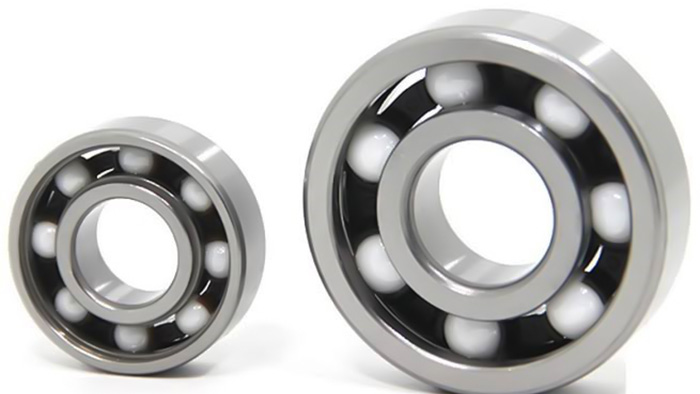
Ceramic bearings are produced either as full ceramic bearings or as hybrid ceramic bearings. In hybrid designs, the rolling elements are ceramic while the rings remain steel. This is a common industrial solution because it combines some of the benefits of ceramic with the structural familiarity of steel raceways.
The most common ceramic material used in bearings is silicon nitride. This material is lighter than steel, extremely hard, resistant to corrosion, and capable of performing well in high speed applications. These properties make ceramic bearings especially attractive where conventional steel bearings approach their performance limits.
Ceramic rolling elements generate less centrifugal force at high rotational speeds because of their lower weight. They also reduce friction and can contribute to lower operating temperatures. In some machinery, this means better efficiency, reduced lubricant stress, and improved service life.
Another major advantage is resistance to corrosion and electrical conductivity. Ceramic materials do not rust like steel and they provide electrical insulation, which is useful in electric motors and other systems where stray current can damage bearing surfaces.
The main concern with ceramic materials is brittleness. Although ceramic is extremely hard, it does not absorb shock in the same way steel does. For that reason, ceramic bearings must be selected carefully in applications with sudden impact loads or harsh mechanical shock.
Our Products: Roller Bearings
Material Differences That Affect Performance
When comparing ceramic vs steel bearings, the material itself explains most of the performance difference. Steel is tougher and more forgiving under heavy or shock loaded conditions. Ceramic is lighter, harder, and more resistant to heat and corrosion.
This means steel bearings are often the better option when the machine faces heavy loads, vibration, impact, or budget limitations. Ceramic bearings become more attractive when the machine operates at very high speed, in corrosive surroundings, under electrical exposure, or in environments where temperature is too high for standard steel performance.
Material selection should never be based on trend or perceived quality alone. It should be based on what the bearing must endure in actual service.
Alma Bearings helps industrial buyers and engineers compare ceramic vs steel bearings based on speed, load, environment, and budget so the final selection matches real operating needs.
Speed Capability
One of the strongest arguments in favor of ceramic bearings is high speed performance. Because ceramic balls are lighter than steel balls, they create lower centrifugal force during rotation. This reduces stress within the bearing and allows higher operating speeds with less heat buildup.
In machine tool spindles, dental systems, turbine related equipment, and certain high performance motors, ceramic bearings can offer clear benefits. Lower friction at high RPM can improve efficiency and support more stable operation over time.
Steel bearings can still perform very well at moderate and even relatively high speeds, especially when properly lubricated and specified. However, when speed becomes extreme, ceramic designs often hold a measurable advantage.
Load Capacity and Shock Resistance
Steel bearings generally remain stronger candidates for heavy loads and sudden impact. Their toughness allows them to deform slightly under stress rather than fracture. This makes them especially suitable for construction equipment, mining systems, gearboxes, conveyors, and other heavy duty industrial machines.
Ceramic bearings can carry substantial loads, especially in hybrid configurations, but they are less forgiving in shock loaded applications. If a machine experiences repeated impacts, misalignment, or aggressive mechanical vibration, steel is often the safer and more durable choice.
This is one of the most important distinctions in ceramic vs steel bearings. Ceramic may outperform steel in speed and corrosion resistance, but steel often outperforms ceramic in toughness and load resilience.
Corrosion Resistance
Corrosion resistance is one of the clearest advantages of ceramic materials. In wet, chemically aggressive, or marine environments, ceramic bearings can maintain performance where steel bearings may rust, stain, or degrade unless they are specially protected.
This makes ceramic and hybrid ceramic bearings attractive in food processing, chemical handling, marine systems, washdown equipment, and humid environments. In these settings, corrosion can shorten bearing life quickly, even if the load and speed are not extreme.
Steel bearings can still be used in such conditions if they include stainless materials, coatings, seals, or careful lubrication strategies. Even so, ceramic often has a natural advantage where corrosion is a constant concern.
Our Products: Angular Contact Ball Bearings
Temperature Performance
High temperature environments place serious stress on standard bearing materials and lubricants. Ceramic materials are better able to tolerate elevated temperatures without losing their core properties as quickly as steel.
In furnaces, specialized industrial processing systems, aerospace components, and high heat rotating equipment, ceramic bearings can provide more stable operation. Their lower thermal expansion and greater temperature resistance help maintain performance where steel may suffer from increased wear or dimensional changes.
That said, temperature performance also depends on lubrication, cage material, seals, and surrounding design. Bearing material is important, but it is only one part of the full thermal picture.
Friction and Energy Efficiency
Lower friction is another commonly cited benefit in the comparison of ceramic vs steel bearings. Ceramic rolling elements typically create less rolling resistance, which can reduce heat generation and improve efficiency.
In applications where energy savings, precision, or speed consistency matter, this can be a meaningful advantage. Lower friction may also reduce lubrication stress and extend maintenance intervals in the right environment.
For many standard machines, however, the efficiency difference may not be large enough to justify the cost of switching from steel to ceramic. The value depends on how sensitive the application is to heat, drag, and speed.
Cost and Value Considerations
Cost is often the deciding factor when comparing ceramic vs steel bearings. Steel bearings are significantly more affordable and remain the most practical solution for most industrial applications. They offer strong value, especially where environmental and speed demands remain within normal limits.
Ceramic bearings cost more because of advanced raw materials, difficult manufacturing processes, and tighter quality requirements. The initial purchase price may be much higher than a comparable steel bearing.
However, higher purchase cost does not always mean poor value. In high speed or corrosive applications, ceramic bearings may reduce downtime, last longer, improve machine performance, and lower maintenance costs. In such cases, the total cost of ownership may justify the investment.
The real decision should not focus only on price. It should compare purchase cost with expected service life, maintenance reduction, production reliability, and failure risk.
Common Industrial Applications for Steel Bearings
Steel bearings remain the preferred solution across a broad range of industrial sectors because they combine durability, availability, and affordability.
- Heavy industrial machinery and gearboxes
- Pumps, motors, conveyors, and fans
- Automotive systems and transmissions
- Construction, mining, and agricultural equipment
- General manufacturing and workshop machinery
These applications typically benefit from the toughness and cost efficiency of steel, especially where load carrying capacity matters more than extreme speed or corrosion resistance.
Our Products: Cylindrical Roller Bearings
Common Industrial Applications for Ceramic Bearings
Ceramic bearings are more specialized and are typically selected where their performance advantages solve a specific technical problem.
- High speed spindles and precision rotating equipment
- Electric motors exposed to stray current
- Chemical, marine, or corrosive environments
- High temperature industrial systems
- Aerospace and advanced performance equipment
In many of these settings, hybrid ceramic bearings are especially popular because they provide a compromise between performance and cost.
Which Is Better?
There is no universal winner in the debate over ceramic vs steel bearings. The better option depends entirely on the machine’s operating conditions and design priorities.
If the application involves standard industrial speeds, substantial loads, tight budgets, or possible shock loading, steel bearings are usually the better and more economical choice. They are proven, durable, and widely trusted.
If the application requires higher speed, lower friction, corrosion resistance, electrical insulation, or high temperature performance, ceramic bearings may provide important operational advantages. In these environments, their higher cost can be justified by better reliability and performance.
Instead of asking which material is better in general, it is more useful to ask which material performs better under the exact working conditions of the machine.
Conclusion
The comparison of ceramic vs steel bearings shows that each material offers distinct strengths. Steel bearings remain the best all around solution for many industrial machines because they are strong, cost effective, and able to tolerate heavy loads and shock. Ceramic bearings offer clear advantages in high speed, corrosive, electrically sensitive, and high temperature environments where steel may face limitations.
Choosing the right bearing is ultimately a matter of application fit. When performance conditions are moderate and cost matters most, steel is often the logical answer. When the machine demands lower friction, higher speed capability, and stronger resistance to corrosion or heat, ceramic or hybrid ceramic bearings can deliver substantial benefits.
A well informed selection process improves equipment reliability, reduces maintenance risk, and supports better long term operating efficiency. That is why understanding ceramic vs steel bearings is essential for anyone responsible for machinery performance.
Contact Alma Bearings for expert guidance and access to high quality bearing solutions for industrial, automotive, and specialized machinery applications.
Our Products: Thrust Ball Bearings
Frequently Asked Questions
1. Are ceramic bearings better than steel bearings?
Ceramic bearings are better in high speed, corrosive, high temperature, and electrically sensitive applications. Steel bearings are generally better for heavy loads, impact resistance, and cost effective general use.
2. Why are ceramic bearings more expensive?
They use advanced materials such as silicon nitride and require more specialized manufacturing processes, which increases production cost.
3. Can ceramic bearings replace steel bearings in all machines?
No. While ceramic bearings offer important advantages, they are not always ideal for heavy shock loaded or budget sensitive applications where steel performs better.
4. Which type lasts longer?
That depends on the operating environment. Ceramic bearings may last longer in extreme conditions, while steel bearings can provide excellent life in normal industrial service.
Comments (0)