
Shopping Cart
There are no more items in your cart
- News
- 0 likes
- 230 views
- 0 comments
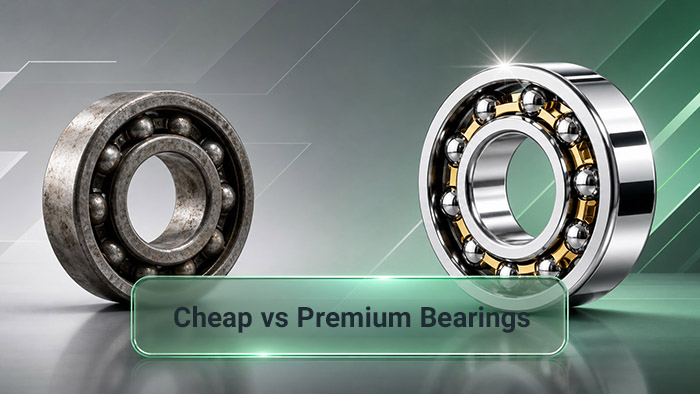
In industrial procurement, one of the most frequent dilemmas involves the choice between initial savings and long term reliability. When a machine breaks down, the immediate reaction is often to find a replacement as quickly and cheaply as possible. However, the decision of cheap vs premium bearings is rarely a simple matter of price. It is a decision about risk, machine uptime, maintenance labor, and the total cost of ownership over the life of the equipment.
Premium bearing manufacturers like SKF, FAG, NSK, and Timken invest millions of dollars in research, metallurgy, and precision manufacturing. At the same time, the market is filled with generic, low cost alternatives that often look nearly identical to their high end counterparts. To an untrained eye, a bearing is just a set of metal rings and balls. To an engineer or a maintenance professional, the difference between a premium product and a budget one is the difference between a machine that runs for five years and one that fails in five months.
This guide explores the technical and economic realities of cheap vs premium bearings. We will look at material quality, manufacturing tolerances, the impact of precision on machine health, and how to calculate whether an expensive bearing is actually the more economical choice in the long run. By understanding these factors, businesses can move away from short term purchasing habits and toward a more strategic approach to industrial reliability.
Our Products: Angular Contact Ball Bearings
Defining Premium Bearings
A premium bearing is defined by more than just a famous brand name on the box. It represents a commitment to high grade materials, strictly controlled heat treatment processes, and extreme manufacturing precision. Manufacturers of premium bearings use ultra-clean steel with very low oxygen content, which reduces the presence of internal impurities. These impurities, known as inclusions, are often the starting point for fatigue cracks that eventually lead to bearing failure.
Beyond the steel itself, premium manufacturers employ sophisticated quality control systems that measure tolerances in microns. This level of accuracy ensures that every bearing in a batch performs exactly like the last one. Premium bearings also feature optimized internal geometry, specialized cage designs, and high performance lubrication options that are tailored to specific industrial needs. When you buy a premium product, you are paying for the engineering depth and the certainty that the part meets global ISO or ABEC standards consistently.
Choosing between cheap vs premium bearings depends on your specific performance goals and budget constraints. Alma Bearings provides expert consultation to help you understand which applications require premium reliability and where you can safely optimize your costs.
The Reality of Cheap or Generic Bearings
Cheap bearings, often referred to as generic or “no-name” bearings, are typically produced with a focus on high volume and low cost. While they may follow the same basic dimensions as premium parts, the internal quality is often inconsistent. The steel used in budget bearings may contain more impurities, and the heat treatment may not be as precise, leading to parts that are either too brittle or too soft.
The manufacturing tolerances in cheaper factories are often wider, meaning that one bearing might fit perfectly while the next one in the same box is slightly off. These small variations in internal clearance or surface finish may not be visible, but they cause significant problems once the bearing is rotating at high speed under load. Cheap bearings are frequently sold through multi-level trading networks where traceability is lost, making it difficult to know exactly where the product was made or if it meets any verified quality standards.
More Bearings: Spherical Plain Bearings
Metallurgy and Material Purity
The most significant difference in the cheap vs premium bearings comparison is often the quality of the steel. Premium manufacturers use vacuum-degassed or even double-vacuum-melted steel to ensure the highest possible purity. Clean steel is essential because it can withstand millions of stress cycles without developing the microscopic cracks that lead to surface spalling.
In contrast, budget bearings are often made from lower grade steel that has higher levels of non-metallic inclusions. Under the intense pressure of industrial loads, these inclusions act as stress concentrators. Eventually, the metal around the inclusion fails, causing a piece of the raceway to flake off. This is why cheap bearings often suffer from “infant mortality” or premature fatigue failure, even if they were installed correctly and lubricated properly.
Precision, Vibration, and Noise
Precision is where the difference between cheap vs premium bearings becomes audible. A high quality bearing is manufactured with extremely smooth surface finishes on the raceways and rolling elements. This smoothness reduces friction, which in turn reduces vibration and noise. In precision machinery, high vibration is a major enemy, as it can damage seals, loosen fasteners, and lead to inaccuracies in the final product.
Cheap bearings often have “chatter marks” or microscopic irregularities on their surfaces because of lower quality grinding and polishing processes. When these bearings run, they generate more heat and noise. This vibration is not just an annoyance; it is energy being wasted and turned into mechanical stress. Over time, this excess vibration can wear out the shaft or the housing, leading to repairs that are far more expensive than the price of a premium bearing.
Heat Treatment and Hardness
The longevity of a bearing depends heavily on the hardness and stability of its components. Premium manufacturers use advanced heat treatment cycles to ensure that the steel has the correct crystalline structure to resist wear. They also perform “dimensional stabilization” to ensure that the bearing rings do not expand or contract significantly when they get hot during operation.
In low cost manufacturing, heat treatment is often a bottleneck in production. To save time and money, some factories may use shorter heating cycles or less precise quenching methods. This results in bearings that may have soft spots or internal stresses. A bearing with inconsistent hardness will wear unevenly, leading to a rapid loss of internal clearance and eventual seizure. In critical applications, this lack of thermal stability can cause a bearing to “walk” on the shaft or get stuck in the housing.
Lubrication and Sealing Quality
Many people overlook the fact that a bearing is a system that includes the metal, the lubricant, and the seals. Premium bearings are often supplied with high quality, brand-name greases that are designed for specific temperature ranges and speeds. Their seals are made from high grade elastomers that remain flexible and maintain a tight lip contact even after thousands of hours of service.
Budget bearings often use generic greases that may not have the necessary additives for extreme pressure or rust inhibition. Furthermore, the seals on cheap bearings are often made from lower quality rubber that can harden and crack over time. Once a seal fails, the lubricant leaks out and contaminants like dust and water enter the bearing. This cycle of contamination and lubrication loss is one of the leading causes of early failure in cheap bearings used in outdoor or washdown environments.
Total Cost of Ownership (TCO)
The most important concept for any maintenance manager to understand is the Total Cost of Ownership. The purchase price of a bearing is often less than 10% of the total cost associated with its use. To truly compare cheap vs premium bearings, one must look at the hidden costs that appear after the purchase.
When a bearing fails, you pay for the replacement part, but you also pay for the labor to remove the old one and install the new one. You pay for the lost production time while the machine is offline. You may also pay for damage to the shaft, the motor, or the gears that were affected by the bearing failure. If a premium bearing costs three times as much as a cheap one but lasts five times longer, it is actually the cheaper option. When you factor in the cost of even a single hour of unplanned downtime, the “savings” from a cheap bearing usually disappear instantly.
Our Products: Deep Groove Ball Bearings
When Is a Cheap Bearing “Good Enough”?
While premium bearings are generally superior, there are specific situations where a budget bearing might be a logical choice. If the application is low speed, has very light loads, and is in a non-critical piece of equipment where failure causes no safety risk or production loss, a cheap bearing might be acceptable. Examples include simple hand carts, low usage manual tools, or basic laboratory equipment where replacement is extremely easy and fast.
However, even in these cases, the risk of inconsistency remains. A cheap bearing might work fine today, but the next one you buy from the same supplier might fail tomorrow. For businesses that value predictability and want to minimize the number of times they have to open a machine, premium bearings remain the standard recommendation.
Key Selection Factors
When deciding between cheap vs premium bearings, consider these practical questions to guide your procurement strategy.
- How much does one hour of downtime cost your facility?
- Is the bearing located in a place that is difficult or dangerous to access?
- Does the application involve high speeds, heavy loads, or extreme temperatures?
- Are you protecting an expensive shaft or a high-value motor?
- Is the machine critical to your overall production line?
- Do you have the labor resources to perform frequent replacements?
If the answer to most of these questions involves high costs or high risks, the investment in a premium brand is almost always justified.
The Impact of Counterfeit Bearings
A major risk in the cheap vs premium bearings market is the rise of counterfeit products. Some unscrupulous suppliers sell low quality bearings in boxes that look like premium brands. They charge a “mid-range” price that is lower than the official distributor but higher than a generic part, making the buyer think they are getting a great deal.
Using a counterfeit bearing is even more dangerous than using a known cheap bearing because you have no idea what the internal quality is. Counterfeits often fail catastrophically and without warning. This is why it is essential to buy premium bearings only from authorized distributors or highly reputable suppliers like Alma Bearings, who can guarantee the origin and authenticity of the product.
Engineering Support and Documentation
Another advantage of premium brands is the level of technical support available. Premium manufacturers provide detailed catalogs, load calculation software, and technical teams that can help solve complex application problems. If a bearing fails prematurely, they can often perform a root cause analysis to determine if the problem was lubrication, installation, or the bearing itself.
Cheap bearing manufacturers rarely offer this level of service. If a budget bearing fails, you are usually on your own to figure out why. For companies that are trying to improve their overall reliability through “Precision Maintenance,” the data and support provided by premium brands are invaluable tools that help prevent future failures.
Our Products: Roller Bearings
Environmental Sustainability
In the modern industrial world, sustainability is becoming a key metric. Premium bearings contribute to a lower environmental footprint because they last longer, meaning fewer raw materials are used over the life of the machine. Furthermore, because premium bearings have lower friction, they reduce the energy consumption of the motors that drive them.
While the energy savings of a single bearing might seem small, the cumulative effect across an entire factory can be significant. Cheap bearings that fail frequently create more waste in the form of discarded metal and contaminated grease. By choosing premium products, companies can align their maintenance goals with their environmental and energy efficiency targets.
Evaluating Brand Reputation
The reputation of a bearing brand is built over decades of performance in the field. Brands like SKF and FAG are leaders because their products have been proven in the most demanding environments on Earth, from deep sea oil rigs to high speed trains. When you choose a premium brand, you are buying that history of performance.
Generic brands do not have this track record. While some newer manufacturers are improving their quality, they often lack the global consistency of the established leaders. For critical industrial operations in Iran and elsewhere, relying on a brand with a proven reputation is the most effective way to manage mechanical risk and ensure peace of mind.
Conclusion
In the debate of cheap vs premium bearings, the initial price tag is often the most misleading piece of information. While cheap bearings offer an attractive way to save money on a purchase order, they frequently lead to higher costs through premature failure, increased vibration, higher energy consumption, and expensive unplanned downtime.
Premium bearings are worth the investment because they offer superior material purity, higher manufacturing precision, better heat treatment, and more reliable sealing and lubrication. These factors translate directly into a longer service life and a lower total cost of ownership. For any application where the cost of a failure is higher than the price of the bearing itself, the choice should always be premium quality.
By focusing on value rather than just price, maintenance and procurement teams can improve the reliability of their equipment and ensure that their operations run smoothly and efficiently. Investing in quality today is the best way to prevent expensive headaches tomorrow.
Protect your machinery from the risks of low quality and counterfeit parts. Contact Alma Bearings for a wide selection of genuine premium bearings and technical support for all your industrial needs.
Our Products: Ball Bearings
Frequently Asked Questions
1. Are premium bearings really better than cheap ones?
Yes. Premium bearings use higher quality steel, more precise manufacturing tolerances, and better lubrication, which results in a significantly longer service life and better machine performance.
2. When is it okay to use cheap bearings?
Cheap bearings can be used in low speed, non-critical applications where failure does not cause production loss or safety risks and where replacement is easy.
3. How do I know if a bearing is genuine or counterfeit?
The best way to ensure authenticity is to buy from authorized distributors or reputable suppliers. Check the packaging, markings, and documentation for consistency, and be wary of prices that are too good to be true.
4. Does the brand of a bearing really matter?
Yes. Established brands have strict quality control and provide technical support and documentation that generic manufacturers often lack. This ensures consistent performance across every part you buy.
5. Can using a cheap bearing damage my machine?
Absolutely. A cheap bearing that fails can cause vibration that damages seals and gears, or it can seize and damage the shaft or housing, leading to very expensive repairs.
Comments (0)