
Shopping Cart
There are no more items in your cart
- News
- 0 likes
- 109 views
- 0 comments
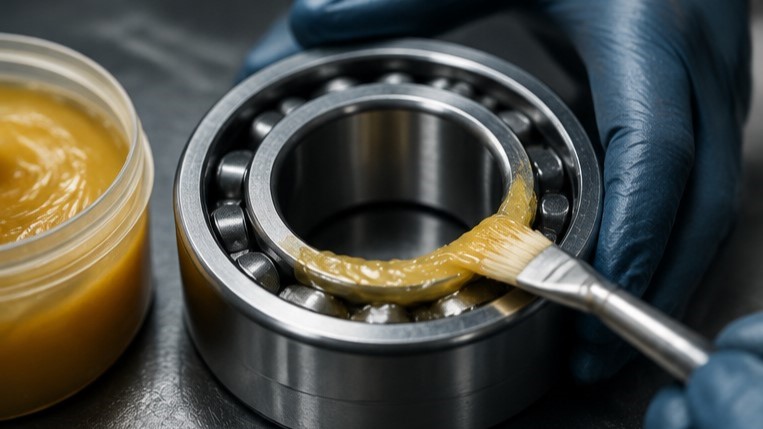
Lubrication is one of the most critical factors governing bearing reliability and service life. A properly engineered lubricant film separates contact surfaces, minimizes friction, limits mechanical wear, controls operational temperatures, and prevents catastrophic bearing failure. In modern industrial operations, the selection between grease and oil directly influences energy consumption, maintenance intervals, operational speeds, and overall equipment effectiveness.
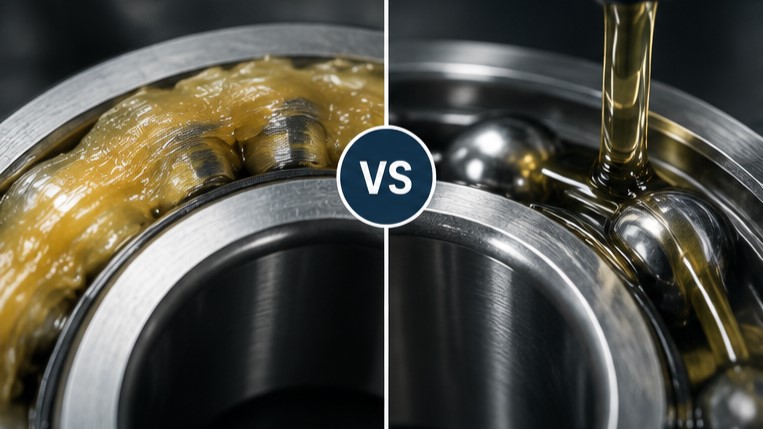
The comparison of grease vs oil lubrication bearings is not merely a matter of convenience or initial purchase cost. Grease and oil possess distinct physical behaviors and thermodynamic properties tailored to specific industrial environments. Grease remains contained within the housing to simplify maintenance, whereas oil excels in high-speed, elevated-temperature environments where active heat dissipation and continuous filtration are non-negotiable.
Selecting the optimal lubrication regime requires evaluating rotational speed, radial and axial loads, operating temperatures, contamination risks, shaft orientation, relubrication logistics, and sealing configurations. A lubricant suitable for an electric motor can cause rapid failure in a high-speed machine tool spindle, industrial gearbox, steam turbine, or heavy-duty process line.
Our Products: Buy ball bearings
What Is Grease Lubrication?
Grease is a semi-solid lubricant formulated from base oil, a thickener matrix, and specialized performance additives. The base oil constitutes the primary lubricating film, while the thickener acts as a sponge that holds the fluid in place within the bearing raceways and housing cavity.
Industrial greases typically utilize mineral or synthetic base oils paired with lithium, lithium complex, polyurea, calcium sulfonate, or aluminum complex thickeners. Performance additives enhance resistance to oxidation, mechanical shear, water washout, extreme pressure, and corrosion.
Grease is packed into the bearing during assembly or replenished through grease fittings during scheduled maintenance. Because of its semi-solid consistency, grease stays within the bearing without requiring complex external delivery mechanisms, making it ideal for vertical shafts and isolated equipment.
The principal advantage of grease lubrication is mechanical simplicity. It delivers reliable lubrication and contamination protection without requiring pumps, oil reservoirs, filtration units, pressure lines, or complex level monitoring instrumentation.
What Is Oil Lubrication?
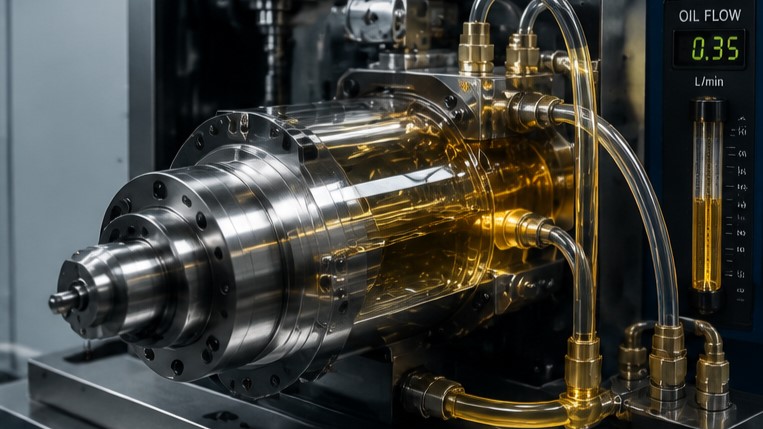
Oil lubrication relies on liquid oil to establish a continuous hydrodynamic or elastohydrodynamic film between rolling elements and raceways. Depending on machine architecture, oil is supplied via oil baths, splash methods, drip feeds, oil-mist, air-oil systems, or pressurized circulating loops.
Liquid oil circulates freely through the bearing cavity to carry away heat generated by rolling friction and external process temperatures. This thermal management capability makes oil the default choice for high-speed bearings and heavy thermal load operations.
Oil systems facilitate online filtration, external cooling, condition monitoring, and scheduled fluid sampling without dismantling the bearing assembly. However, they demand precise engineering, tighter sealing arrangements, and regular monitoring of viscosity, cleanliness, oil levels, and flow rates.
While oil provides superior cooling and film formation under extreme conditions, an interruption in supply, viscosity loss, or particulate contamination can lead to rapid bearing seizure.
Grease vs Oil Lubricated Bearings: Technical Comparison
| Technical Factor | Grease Lubrication | Oil Lubrication |
|---|---|---|
| Physical State | Semi-solid structure | Free-flowing liquid |
| System Complexity | Minimal to moderate | Moderate to highly complex |
| High-Speed Capability | Moderate (limited by churning) | Superior (especially with air-oil/mist) |
| Thermal Dissipation | Poor (localized heat retention) | Excellent (active heat removal) |
| Leakage & Sealing | Low leakage risk; acts as a seal | Higher leakage risk; requires precise seals |
| Maintenance Overhead | Periodic manual/auto regreasing | Monitoring level, cleanliness, and filtration |
| Shaft Orientation | Highly versatile (horizontal/vertical) | Sensitive (requires tailored reservoirs/pumps) |
| Contamination Handling | Traps contaminants locally | Requires inline filters to prevent circulation |
| Capital Expenditure | Low initial installation cost | Higher initial cost (pumps, piping, coolers) |
| Fluid Replacement | Regreasing/purging old grease | Draining, flushing, and refilling fluid |
| Core Applications | Motors, conveyors, fans, pumps | Spindles, gearboxes, turbines, compressors |
This overview provides general operational guidelines. Actual performance depends on bearing internal geometry, operating speed, dynamic loading, thermal conditions, seal topology, lubricant viscosity, and manufacturer design parameters.
Our Products: Buy Roller Bearings
Operational Speed and Thermal Dynamics
Rotational speed is a defining parameter in the grease vs oil lubrication bearings decision. As rotational velocity rises, internal friction generates considerable heat. If this thermal energy is not dissipated, the lubricant film collapses, leading to surface distress and accelerated fatigue.
Grease supports moderate to high speeds depending on base oil viscosity and thickener type. However, excessive grease fill causes severe churning, where rolling elements work against the lubricant mass. This generates friction, elevates operating temperature, accelerates base oil oxidation, and degrades thickener stability.
Liquid oil excels at elevated rotational speeds because lubricant delivery can be metered precisely. Excess fluid drains away from the contact zone, preventing churning losses. Specialized air-oil and direct jet lubrication systems are essential for high-speed spindles, gas compressors, and turbochargers.
Oil circulation absorbs thermal energy directly from the raceways and transfers it to external heat exchangers, stabilizing operating temperatures. Grease lacks this convective cooling capability, making it vulnerable in continuous high-thermal operations unless the bearing is oversized or specifically rated for the environment.
Load Carrying and Elastohydrodynamic Film Formation
The capacity of a lubricant to carry mechanical load depends on its operating viscosity, base oil chemistry, additive formulation, and elastohydrodynamic lubrication (EHL) film thickness. Both grease and oil provide robust load-carrying capabilities when specified correctly.
Grease excels in heavy-load, low-speed, or oscillating applications where maintaining a hydrodynamic film is challenging. The thickener matrix helps retain lubricant within the loaded contact zone, while extreme-pressure (EP) and solid additives (such as molybdenum disulfide) prevent micro-welding under boundary conditions.
Oil delivers consistent load support across medium to high speeds by maintaining a reliable fluid film. In circulating systems, fresh, cooled oil enters the contact zone continuously, preserving uniform viscosity and load-bearing performance.
For heavy industrial applications, lubricant selection must consider base oil viscosity at actual operating temperatures, bearing speed parameters (), dynamic load ratings, contamination ratings, and OEM specifications.
Operating Temperature and Environmental Sealing
Lubricant selection must account for ambient conditions, operating thermal cycles, and environmental exposure. Elevated temperatures accelerate oxidation, thin the base oil, and degrade grease thickener structures, causing premature oil bleeding.
Standard mineral greases operate reliably within moderate industrial temperature bands. Extreme low or high temperatures require synthetic formulations like PAO, ester, or silicone-based greases. However, high-temperature greases often demand shortened relubrication intervals due to accelerated thermal aging.
Oil viscosity drops predictably as temperature rises. If viscosity drops too low, the fluid film thins and allows metal-to-metal contact. Conversely, excessive viscosity at cold startup generates high torque and fluid friction. Liquid systems mitigate this via inline heaters and heat exchangers.
Grease forms an auxiliary barrier that prevents dust, moisture, and particulate ingress, making it highly effective in abrasive environments. However, once contaminants penetrate grease, they remain trapped against raceways. Oil systems rely on external seals but offer the advantage of inline filtration to continuously remove abrasive particles.
Our Products: Tapered Roller Bearings
Maintenance Procedures and Total Cost of Ownership
Grease simplifies routine maintenance by eliminating auxiliary pumps, pressure regulators, and supply lines. Technicians replenish grease via manual grease guns or single-point automatic lubricators without interrupting machine operation.
Nevertheless, grease maintenance requires strict discipline. Over-greasing is a primary cause of bearing failure, driving up temperatures, rupturing contact seals, and causing motor winding contamination. Mixing incompatible thickeners can cause catastrophic softening and complete grease evacuation.
Oil systems involve higher capital investment and ongoing maintenance oversight. Technicians must monitor fluid levels, inspect sight glasses, evaluate filter differential pressures, and send oil samples for spectrographic analysis. Oil sampling enables predictive maintenance by detecting early component wear and moisture contamination before physical failure occurs.
While grease offers lower initial equipment costs, centralized oil systems reduce labor and extend bearing life in critical 24/7 continuous process lines, optimizing total cost of ownership.
Industrial Application Profiles
Grease lubrication dominates standard industrial equipment where simplicity, reliability, sealed containment, and low operational overhead are paramount. Common applications include:
- Electric motors, industrial blowers, exhaust fans, and water pumps
- Material handling systems, belt conveyors, overhead cranes, and bucket elevators
- Construction, mining, and heavy agricultural machinery
- Factory automation, packaging lines, and linear motion guides
- Mounted pillow block and flanged bearing units
- Factory-sealed deep groove ball bearings in consumer and light commercial devices
Oil lubrication is preferred for heavy-duty, high-precision, continuous-duty, or severe thermal applications requiring active heat removal and filtration. Common applications include:
- High-speed CNC machine tool spindles and precision boring heads
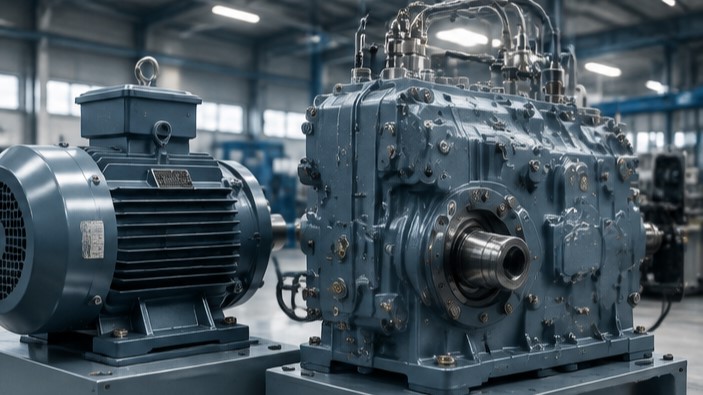
- Heavy-duty gear reducers, planetary gearboxes, and industrial transmissions
- Steam and gas turbines, centrifugal compressors, and power generation units
- Paper mill drying sections, continuous casters, and hot rolling mills
- High-pressure hydraulic pumps and fluid-drive power transmissions
- Enclosed multi-component drivelines sharing a common lubrication reservoir
Common Engineering and Lubrication Pitfalls
A common error is selecting grease solely for operational convenience without verifying speed limits () and thermal dissipation needs. Operating grease beyond its design envelope leads to rapid thickener breakdown and bearing seizure.
Another mistake involves using oil with incorrect operating viscosity. Overly thin oil causes boundary contact and adhesive wear, while overly viscous oil generates excessive fluid drag, parasitic power loss, and elevated operating temperatures.
Technicians also frequently assume sealed-for-life bearings never fail due to lubrication. Sealed units have a finite grease service life dictated by temperature, speed, and environmental exposure; when the grease degrades, the bearing must be replaced.
Finally, lubricant cross-contamination remains a widespread issue. Combining incompatible greases (such as lithium and polyurea) destroys thickener structure, while blending dissimilar oil formulations causes additive dropout and loss of anti-wear protection.
Systematic Selection Framework
To decide between grease and oil lubrication:
- Calculate the speed factor (): High speed factors typically necessitate circulating oil or air-oil systems, while moderate factors are well-suited to grease.
- Evaluate thermal dissipation demands: If external process heat or high internal friction must be actively removed, choose circulating oil.
- Assess physical access and orientation: Use grease for vertical shafts, remote bearings, or locations where running oil lines is impractical.
- Determine contamination and environmental risks: Use grease to aid sealing in dusty environments, or utilize oil with high-efficiency inline filtration for sensitive, clean systems.
- Analyze lifecycle economics: Balance the lower installation cost of grease against the predictive monitoring and extended life advantages of circulating oil systems.
Conclusion
The selection of grease vs oil lubrication bearings requires balancing mechanical performance against operational demands. Grease delivers self-contained simplicity, effective sealing assistance, low initial installation cost, and minimal infrastructure requirements, making it the preferred choice for the majority of standard industrial machines.
Oil provides unmatched heat removal, high-speed capability, continuous particulate filtration, and comprehensive condition-monitoring options. It remains indispensable for heavy-duty gearboxes, precision spindles, continuous process equipment, and critical turbomachinery.
Achieving maximum bearing service life requires evaluating dynamic load ratings, operational velocities, thermal profiles, environmental exposure, maintenance capabilities, and lifecycle costs. Matching the correct lubrication regime with genuine, precision-manufactured bearings ensures sustained operational reliability, reduced downtime, and lower total maintenance costs.
Alma Bearings supplies genuine industrial bearings, high-performance housings, and specialized lubrication accessories. Consult with our technical specialists to source reliable components engineered to maximize machine uptime and operational efficiency.
Our Products: Buy Deep Groove Ball Bearings
Frequently Asked Questions
1. Is grease or oil better for high-speed bearings?
Oil is generally superior for high-speed bearings. Liquid lubricants avoid the churning friction and heat generation associated with semi-solid grease, especially when delivered via precision air-oil or oil-mist systems.
2. Can you convert a grease-lubricated bearing housing to oil lubrication?
Conversions are possible but require modifying the housing, installing oil-tight seals, adding sight glasses, ensuring correct drainage paths, and calculating proper fluid levels to prevent starvation or churning.
3. What causes grease churning inside a bearing?
Churning occurs when a bearing housing is overfilled with grease. The rolling elements continuously plow through excess lubricant, generating severe fluid friction, elevated temperatures, and accelerated grease degradation.
4. How do I determine if a bearing needs extreme pressure (EP) additives?
EP additives are recommended for heavily loaded, shock-loaded, or low-speed bearings where a full elastohydrodynamic fluid film cannot be maintained, preventing adhesive wear and surface welding.
5. Why do vertical shafts favor grease lubrication?
Grease stays in place within the bearing raceways without draining downward. Oil requires specialized lip seals, standpipes, or dedicated circulating pump systems to maintain lubrication on vertical shafts.
Comments (0)