
Shopping Cart
There are no more items in your cart
- News
- 0 likes
- 134 views
- 0 comments
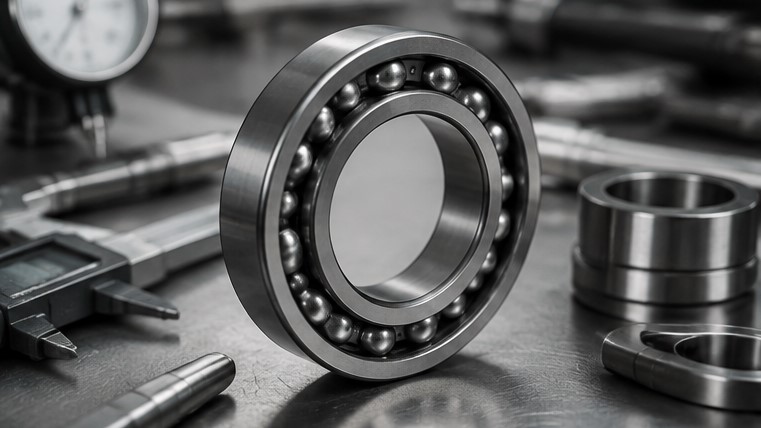
Selecting the correct bearing configuration is essential for the operational reliability, mechanical efficiency, and service life of rotating machinery. One of the most important decisions in industrial equipment design and plant maintenance is the engineering comparison between single row vs double row bearings. Although both configurations utilize rolling elements positioned between precision inner and outer rings, their internal construction creates significant differences in radial load capacity, limiting speeds, structural stiffness, axial load support, misalignment tolerance, installation requirements, and lifecycle costs.
A single-row bearing incorporates one continuous row of rolling elements, making it compact, low-friction, and exceptionally well-suited for high-speed, general-purpose industrial machinery. A double-row bearing incorporates two parallel or angled rows of rolling elements within a single outer ring assembly. This configuration substantially increases the effective contact area and structural stiffness, allowing the assembly to support severe radial forces and resist shaft deflection under harsh operating conditions.
However, choosing a double-row bearing is not universally optimal for every rotating shaft. The additional rolling elements introduce more contact surfaces, which naturally increases internal friction, operating temperature, axial width, and procurement costs. Furthermore, double-row units demand tighter mounting tolerances and precise lubrication regimes. Conversely, a single-row bearing offers reduced rolling friction, superior high-speed performance, simplified replacement procedures, and broad market availability.
Selecting between these two bearing configurations requires an objective engineering evaluation of operating parameters, including radial and axial loads, rotational velocity, shaft bending moments, angular misalignment, operating temperature, lubrication method, housing space limits, and expected fatigue life. This guide provides a comprehensive technical breakdown of single-row and double-row bearings to establish a reliable framework for equipment design and component selection.
Our Products: Buy Ball Bearings online
What Is a Single-Row Bearing?
A single-row bearing consists of one set of rolling elements—such as balls, cylindrical rollers, tapered rollers, or spherical rollers—retained within a single cage assembly between precision-ground inner and outer rings. Single-row deep groove ball bearings represent the most common rotating component in modern machinery because they provide smooth running, high rotational speed capabilities, and the versatility to carry radial loads alongside moderate bidirectional axial forces.
The primary mechanical advantage of a single-row bearing is its compact cross-sectional profile. Because it houses only one track of rolling elements, it minimizes axial envelope space within bearing housings while generating exceptionally low frictional torque. This characteristic makes single-row designs the standard choice for high-speed industrial electric motors, centrifugal pumps, ventilation blowers, compressors, and high-efficiency drives where heat generation must be kept to a minimum.
Single-row bearings are also straightforward to install, inspect, and service. Their symmetric and straightforward internal geometry exhibits greater tolerance to minor mounting imperfections compared to complex multi-row assemblies. Technicians can seat single-row bearings onto shafts using standard mechanical presses or induction heaters without managing multi-axis preloads across separate raceways.
The primary engineering limitation of a single-row bearing is its finite dynamic and static load capacity. Because the total applied radial load is concentrated across a single row of rolling elements, localized contact stress on raceways rises sharply in heavy-duty machinery. Severe shock loads, high overturning moments, or excessive radial forces can quickly initiate subsurface micro-cracks, leading to premature raceway spalling and catastrophic bearing failure.
What Is a Double-Row Bearing?
A double-row bearing incorporates two distinct rows of rolling elements housed within a unified inner and outer ring structure. Common industrial examples include double-row deep groove ball bearings, double-row angular contact ball bearings, double-row tapered roller bearings, and double-row spherical roller bearings. These rows can be oriented in parallel, back-to-back, face-to-face, or along a curved outer raceway designed for self-aligning capabilities.
The primary objective of a double-row arrangement is to increase dynamic load ratings and radial stiffness without excessively expanding the outer diameter of the bearing housing. Distributing operational forces across twice as many rolling elements substantially reduces contact stress at individual raceway interfaces. This makes double-row configurations indispensable for heavy equipment such as mining crushers, industrial gearboxes, material handling conveyors, heavy vibrating screens, and vehicle hub assemblies.
Double-row angular contact bearings excel in applications requiring substantial bidirectional axial thrust coupled with high radial loads. Meanwhile, double-row spherical roller bearings utilize barrel-shaped rollers running inside a common spherical outer ring, allowing the bearing to accommodate significant shaft deflection and housing misalignment while carrying severe radial and thrust forces.
Despite their high load capacities, double-row bearings present specific operating trade-offs. The higher number of moving contact points generates greater internal friction and heat at high speeds, which can degrade lubricating grease prematurely. They also require wider axial housing space and impose stricter requirements on lubricant replenishment, shaft runout precision, and initial installation accuracy.
Our Products: Buy Roller Bearings online
Core Difference Between Single Row and Double Row Bearings
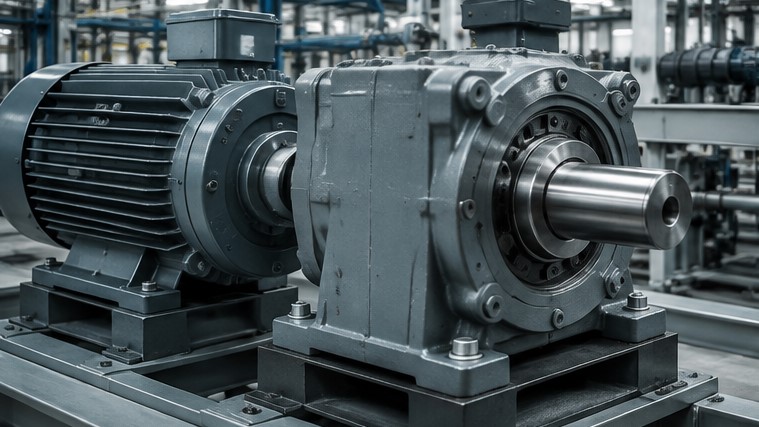
The fundamental engineering distinction between single-row and double-row bearings lies in their internal geometry and load-sharing dynamics. While single-row bearings prioritize low friction, compact width, and high limiting speeds, double-row bearings prioritize maximum load distribution, elevated dynamic capacity, and high resistance to shaft deflection.
From an application standpoint, an engineer designing an electric motor running at 3,000 RPM will select a single-row deep groove bearing to minimize power loss and thermal buildup. In contrast, an engineer designing an intermediate drive shaft inside a multi-stage helical reduction gearbox will choose a double-row bearing to withstand heavy radial separation forces produced by gear tooth contact without excessive shaft deflection.
Crucially, components sharing identical bore and outside diameters can exhibit fundamentally different performance profiles depending on their row configuration. A double-row bearing occupying the same shaft diameter provides significantly higher dynamic load capacity than a single-row bearing, but it requires higher drive torque and runs at lower permissible maximum speeds. Equipment designers must evaluate the complete drive assembly rather than focusing solely on nominal dimensions.
Load Capacity and Bearing Life
Dynamic and static load capacities serve as primary criteria when deciding between single-row and double-row bearings. A double-row bearing distributes radial forces across two sets of rolling elements, which effectively cuts the Hertzian contact stress experienced by individual balls or rollers. This expanded contact surface provides higher dynamic load ratings () and static load ratings (), translating directly to longer bearing fatigue life under severe operational loading.
In heavy-duty industrial machinery, such as industrial agitators, heavy rolling mills, and mining pulverizers, equipment components are subjected to relentless radial forces, material shock loads, and high drive belt tension. If a single-row bearing is improperly specified in such an environment, the rolling elements will experience contact pressures exceeding material yield limits, resulting in rapid raceway indentation, surface fatigue flaking, and cage collapse.
However, installing a double-row bearing does not automatically resolve bearing failure issues if other operating parameters are neglected. If a double-row unit is installed without adequate radial internal clearance or suffers from poor lubrication, internal friction will escalate rapidly. Furthermore, running a high-capacity double-row bearing under extremely light loads can cause rolling elements to skid rather than roll, leading to severe adhesive smearing along the raceways.
For light-to-moderate radial loads, a correctly calculated single-row bearing often provides an optimal operational life at a fraction of the initial cost and maintenance complexity. Calculating the required service life based on ISO 281 standards allows plant engineers to select the exact bearing configuration that matches the machine’s load cycle without over-engineering the assembly.
Radial and Axial Load Handling
Understanding the vectors of applied forces is vital for correct bearing selection. Single-row deep groove ball bearings are inherently versatile, capable of managing pure radial loads and moderate axial thrust forces in both directions. Because their deep raceway grooves closely conform to the balls, they maintain stability under light reversing axial thrusts, making them practical for general pumping and ventilation equipment.
Double-row bearing configurations provide superior multi-directional load handling under complex industrial conditions. For example, double-row angular contact ball bearings feature contact angles inclined relative to the radial plane, allowing them to support heavy combined loads. Because the two rows can be configured in a back-to-back arrangement, they offer exceptional rigidity and can absorb reversing axial thrust loads alongside heavy radial forces without requiring paired single-row bearing sets.
Double-row spherical roller bearings provide exceptional capacity for high radial loads alongside moderate axial forces in both directions. Their internal geometry allows the barrel rollers to adjust within the curved outer raceway, ensuring that applied radial loads are evenly shared across both rows even when the drive shaft undergoes dynamic elastic bending under heavy loads.
When an application experiences high unidirectional or bidirectional thrust forces that exceed the capacity of a single-row bearing, switching to a double-row angular contact or spherical roller design prevents cage deformation, reduces raceway edge loading, and stabilizes shaft axial position.
Speed Capability and Heat Generation
Operational speed limits are dictated by the friction generated within the bearing raceways, cages, and lubricant. Single-row bearings contain fewer rolling elements and less internal surface area in contact with lubricants, resulting in lower rolling resistance and minimal churning losses. This low frictional profile enables single-row deep groove bearings to operate reliably at elevated RPMs with minimal thermal expansion.
Double-row bearings exhibit higher internal friction due to the duplicated number of rolling elements and larger contact geometry. At identical rotational speeds, a double-row bearing churns more lubricant and generates higher operating temperatures than a single-row bearing. Consequently, manufacturer catalogs specify lower limiting speeds () and thermal reference speeds () for double-row bearings within the same dimensional series.
Operating a double-row bearing at elevated speeds requires engineered lubrication strategies, such as synthetic polyalphaolefin (PAO) oils, controlled oil-mist injection, or high-speed polyurea greases, along with precision-machined brass cages. If thermal dissipation is insufficient, the elevated heat generated by a double-row bearing will cause the inner ring to expand rapidly, closing internal clearances and leading to catastrophic thermal seizure.
Our Products: Buy Angular Contact Ball Bearings online
Stiffness and Moment Loads
Mechanical stiffness refers to a bearing’s resistance to elastic deformation under external loads. Double-row bearings provide significantly higher structural rigidity than single-row equivalents because the twin tracks of rolling elements create a broad support base. This broad effective spread provides substantial resistance against overturning moments and tilting forces that attempt to skew the shaft relative to the housing.
Overturning moment loads frequently occur in cantilevered installations, such as overhung belt pulleys, heavy industrial fan impellers, mixer shafts, and vehicle wheel spindles. In an overhung configuration, the radial force acting beyond the bearing center creates a lever arm that generates an angular tilting moment. A single-row bearing subjected to severe moment loads suffers severe edge stress on its raceways, resulting in rapid localized fatigue. A double-row bearing, particularly in a back-to-back contact configuration, provides the necessary rigidity to resist these moments.
Stiffness is also a critical requirement in precision machine tool drives, printing cylinders, and high-load reduction drives where shaft deflection must not compromise gear tooth alignment or product tolerances. By limiting micro-deflections under variable loads, double-row bearings maintain precise shaft positioning, lower high-frequency mechanical vibrations, and protect related machine components such as dynamic mechanical seals and shaft couplings.
Misalignment and Housing Conditions
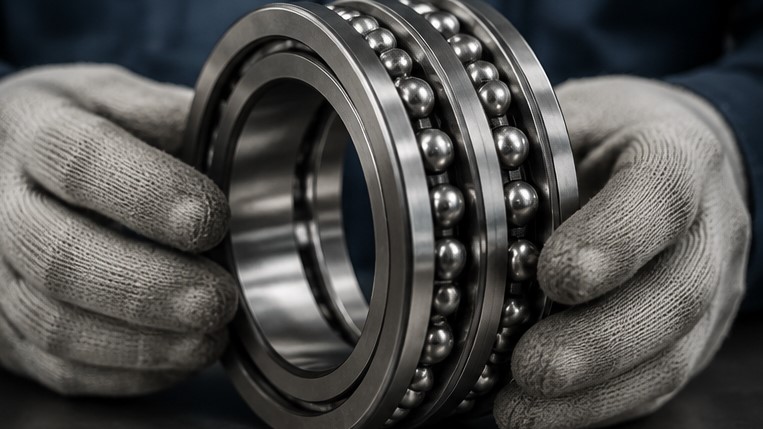
Shaft deflection and housing misalignment represent common operational challenges in industrial rotating equipment. Structural misalignment can result from machining tolerances, thermal growth differentials, dynamic shaft bending under heavy operating loads, or weak foundation bedplates.
Standard single-row deep groove ball bearings and cylindrical roller bearings possess minimal tolerance for angular misalignment, typically accommodating no more than 2 to 10 arcminutes of angular error. When a single-row bearing is subjected to angular misalignment, the contact stress distribution shifts entirely to the raceway shoulders, leading to severe localized pressure, cage failure, and sharp temperature increases.
Certain double-row configurations are specifically engineered to accommodate severe angular misalignment. Double-row spherical roller bearings and self-aligning double-row ball bearings feature an outer ring with a continuous concave spherical raceway. The rolling element rows and inner ring pivot freely within this spherical surface, allowing the bearing to accommodate angular misalignment of 1.5 to 3 degrees without increasing internal friction or diminishing theoretical fatigue life.
However, not all double-row bearings are self-aligning. Rigid double-row angular contact ball bearings and double-row cylindrical roller bearings are highly sensitive to angular errors. Misaligning a rigid double-row bearing causes one row to absorb the entire operational load while the other row is unloaded, causing rapid uneven wear. Designers must select self-aligning double-row designs when structural rigidity cannot be guaranteed.
Installation, Lubrication, and Maintenance
Single-row bearings offer straightforward installation and maintenance procedures. Their symmetric geometry allows them to be mounted onto shafts using hydraulic nuts, induction heaters, or basic mechanical sleeves without complex axial adjustments. Lubrication distribution within a single-row bearing is simple; grease migrates freely across the single track, minimizing grease starvation risks and reducing churning losses.
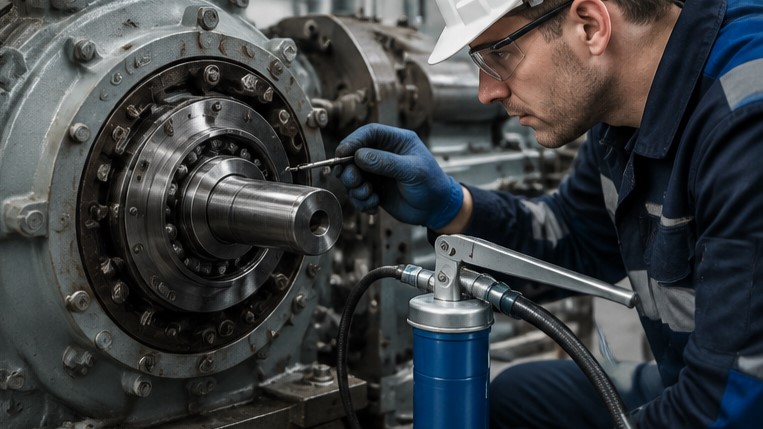
Installing double-row bearings requires meticulous adherence to manufacturer specifications. Because radial clearance must be evenly distributed across both rows, driving a tapered-bore double-row bearing onto an adapter sleeve requires precise feeler gauge clearance measurements or hydraulic drive-up methods. Uneven mounting force can preload one row against the other, causing immediate overheating upon machine startup.
Lubrication management is equally demanding for double-row assemblies. Relubrication ports and annular grooves (such as the W33 feature in spherical roller bearings) are required to deliver grease directly between the two rows of rolling elements. Maintenance technicians must avoid over-greasing double-row housings, as the trapped lubricant volume between the two rows can create extreme hydraulic drag, escalating operating temperatures.
Condition monitoring protocols should be established for critical double-row bearings. Regular vibration spectral analysis (FFT), high-frequency envelope demodulation, and thermal imaging allow plant technicians to detect early subsurface fatigue, cage degradation, and lubrication breakdown well before component failure forces an unplanned plant outage.
Our Products: Buy Deep Groove Ball Bearings online
Space, Cost, and Replacement Availability
Physical space constraints within machine housings frequently dictate bearing configuration choices. Single-row bearings require minimal axial housing width, making them indispensable in compact gearheads, narrow drive housings, and electric motor end-shields where axial length is strictly limited.
Double-row bearings require wider housings and longer shaft seats, which can increase the overall mass and footprint of the machinery. However, utilizing a single double-row angular contact bearing can eliminate the need to machine complex housing shoulders for two separate single-row bearings, simplifying overall housing fabrication.
From a procurement perspective, standard single-row bearings are highly standardized commodity components stocked globally across numerous supply chains, ensuring short lead times and low purchase prices. Double-row bearings—particularly specialized spherical or precision angular contact variants—involve higher manufacturing costs, complex heat treatment, and higher purchase prices. Maintenance planners must weigh these initial purchase costs against the extended operational life and reduced downtime achieved in heavy-load applications.
Typical Industrial Applications
Single-row bearings serve as the standard rotating element across a broad spectrum of industrial equipment. They are commonly installed in standard three-phase electric motors, centrifugal water pumps, blowers, inline conveyors, fractional horsepower gearboxes, machine tool spindles, and light-duty material handling machinery where operating speeds are high and applied loads remain moderate.
Double-row bearings are heavily utilized in harsh, heavy-duty processing industries. Typical installations include heavy industrial reduction gearboxes, mining jaw and cone crushers, vibratory screening decks, heavy slurry pumps, rolling mill run-out tables, heavy-duty belt conveyor pulleys, wind turbine main shafts, and automotive wheel hub units where high radial loads, shock forces, and shaft bending moments are continuous operational realities.
Selection Criteria
Specifying the correct bearing arrangement requires a systematic engineering review of the machine’s actual duty cycle, operating environment, and operational targets. Engineers should analyze the following key criteria to determine the appropriate bearing configuration:
- Single-Row Profile: Recommended for high rotational speeds, low starting torque and low running friction requirements, narrow axial housing envelopes, pure radial or moderate combined loads, and standard general-purpose industrial equipment.
- Double-Row Profile: Recommended for heavy radial load applications, severe shock loading, high overturning moment forces, required structural stiffness, and operating conditions where dynamic shaft deflection requires self-aligning capabilities.
The final engineering decision must verify limiting speed ratings against operating RPM, validate lubricant viscosity at operating temperatures, establish correct shaft and housing fit tolerances (such as k5, m5, or H7), and determine appropriate radial internal clearance (CN, C3, or C4) to ensure maximum equipment reliability.
Conclusion
Evaluating single row vs double row bearings requires balancing dynamic load requirements and structural stiffness against operational speed, frictional losses, and spatial constraints. Single-row bearings deliver exceptional high-speed performance, low energy consumption, compact axial dimensions, and cost-effective maintenance across general industrial machinery. Double-row bearings provide the high load ratings, moment resistance, and structural stability required to maintain shaft integrity under severe industrial loading and harsh environmental conditions.
Plant engineers and equipment designers must evaluate radial and axial load vectors, operating speeds, lubrication methods, alignment tolerances, and total lifecycle costs rather than relying solely on nominal bearing dimensions. Selecting the bearing configuration that matches the mechanical demands of the application maximizes machine uptime, prevents catastrophic failures, and optimizes overall plant productivity.
Need technical assistance selecting between single-row and double-row bearings for your industrial machinery? Contact the engineering team at Alma Bearings for expert guidance on bearing selection, load life calculations, clearance optimization, and lubrication solutions.
Our Products: Buy Bearings Inserts online
Frequently Asked Questions
1. Is a double-row bearing always superior to a single-row bearing?
No. A double-row bearing provides higher load capacity and rigidity, but it creates more friction and heat at high speeds. For light-to-moderate loads at high rotational speeds, a single-row bearing is more efficient and reliable.
2. Can a single-row bearing be directly replaced with a double-row bearing?
Only if the housing width, shaft seat, internal clearances, speed ratings, and lubrication provisions are compatible. Identical bore and outside diameters do not ensure functional or dimensional interchangeability.
3. Which configuration is better suited for high-speed machinery?
Single-row bearings are generally better suited for high-speed operation because they contain fewer rolling elements, generating less friction, churning, and operating heat.
4. How do single-row and double-row bearings handle axial thrust loads?
Single-row deep groove bearings support moderate bidirectional thrust loads, while single-row angular contact bearings carry high thrust in one direction. Double-row angular contact bearings reliably manage heavy thrust loads in both axial directions.
5. Are all double-row bearings capable of handling shaft misalignment?
No. Only specific double-row designs, such as spherical roller bearings and self-aligning ball bearings, accommodate shaft misalignment. Rigid double-row angular contact and cylindrical roller bearings are sensitive to angular misalignment.
Comments (0)